
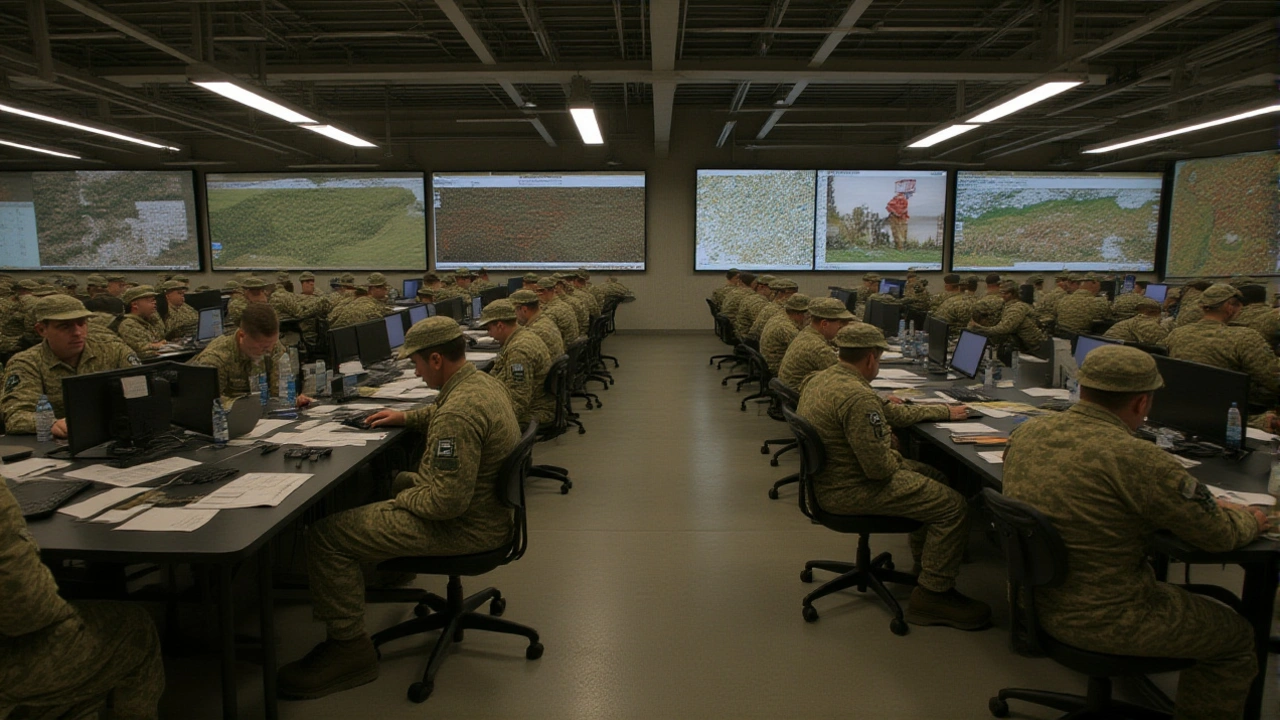
From July 22 to August 8, 2025, the most sophisticated joint command exercise in recent memory unfolded not on a battlefield, but inside a high-tech simulation center at Kirtland Air Force Base in Albuquerque, New Mexico. Bamboo Eagle 25-3 didn’t fire a single bullet — yet it may have shaped the future of American warfare more than many real-world operations. Hosted by the 705th Combat Training Squadron, the exercise used a live, virtual, and constructive (LVC) environment to simulate contested, degraded, and chaotic combat scenarios where communication lines fail, enemy jamming disrupts radar, and split-second decisions determine victory or defeat. No lives were at risk. No aircraft were lost. But the stakes? As high as it gets.
The Synthetic Battlefield That Feels Real
At the heart of the exercise was the Distributed Mission Operations Center (DMOC) — a nerve center built not for display, but for pressure. Here, Air Force, Army, Navy, and Marine Corps personnel sat side by side, not as separate branches, but as one integrated command team. They weren’t watching a simulation. They were living it. Through headsets and holographic displays, they tracked enemy movements, coordinated drone strikes, redirected air support, and managed electronic warfare — all in real time, under simulated cyberattacks and signal blackouts.
"The DMOC enables mission command by offering a safe, synthetic mission set where the BMC2 community can execute commander’s intent without real-world risk," said Major David Blessman, the exercise director. "This is where we integrate at scale with the joint force to sharpen deterrence and ensure we’re ready to fight and win, if called."
Warfighters, Not Just Observers
What made Bamboo Eagle 25-3 different from past drills wasn’t just the tech — it was the people. Lieutenant Colonel David Jones, commander of the 705th Combat Training Squadron/DMOC, noted that frontline operators — pilots, ground controllers, cyber specialists — didn’t just participate. They designed the scenarios. "Warfighters integrated into the DMOC’s LVC environment, directly shaping scenario development, execution, and assessment," he explained. "Their presence helped drive realism, cultural fluency, and collaborative planning."
That’s critical. Too often, training exercises are designed by staff officers who’ve never been in a cockpit or a forward command post. Here, the people who’d actually be making decisions under fire had a say in what the chaos looked like. One scenario involved a naval task force under cyberattack, with air support delayed by jammed datalinks. A Marine forward observer had to improvise a targeting solution using only handheld radios and satellite imagery — a situation that’s become alarmingly common in modern conflicts.
Command Structure: Centralized, But Not Micromanaged
The exercise operated under a framework called "Centralized Command, Distributed Control, Decentralized Execution." In plain terms: senior leaders set the objective. Mid-level commanders decided how to allocate resources. And frontline teams — often hundreds of miles apart — made tactical calls on their own, within broad parameters. This isn’t just doctrine. It’s survival.
"In a real fight, you won’t have time to call headquarters for approval," said one anonymous Air Force battle manager who participated. "You’ll have a 90-second window to decide whether to launch a strike, hold back, or redirect. This exercise forced us to trust each other’s judgment — and that trust doesn’t come from manuals. It comes from sweating through the same simulation, over and over."
Why This Matters Beyond the Base
Kirtland’s DMOC isn’t just a training ground. It’s a national asset. The U.S. military has spent over $1.2 billion since 2018 building this kind of synthetic training infrastructure — and Bamboo Eagle 25-3 was its most complex test yet. With near-peer adversaries like China and Russia investing heavily in electronic warfare and anti-access systems, the ability to rehearse in degraded environments isn’t optional. It’s existential.
Recent conflicts — from Ukraine to the Red Sea — have shown that command centers are now primary targets. If your network goes down, your weapons go blind. Bamboo Eagle 25-3 forced participants to operate without GPS, without secure comms, even without real-time intelligence feeds. And they still succeeded. That’s not luck. That’s preparation.
What Comes Next?
The lessons from this exercise are already being folded into the next iteration of Joint All-Domain Command and Control (JADC2), the Pentagon’s flagship modernization effort. The 705th Combat Training Squadron plans to expand the DMOC’s capacity by 40% by 2026, adding space and cyber warfare nodes. Navy E-2D Hawkeye crews will join next year. So will British and Australian partners — a sign this isn’t just an American exercise anymore.
"We’re not training for the last war," said Major Blessman. "We’re training for the next one. And the next one won’t look like anything we’ve seen before."
Behind the Scenes: The Human Element
Beneath the screens and servers, the real breakthrough was cultural. For years, service branches operated in silos — Air Force planners didn’t understand Marine logistics, Navy commanders didn’t speak Army terminology. Bamboo Eagle 25-3 broke that down. By forcing joint teams to rely on each other in high-stress simulations, it built something no manual can teach: mutual respect.
"I used to think the Army was slow," admitted a Navy strike coordinator. "Then I saw them move a command post under simulated artillery fire — faster than my ship’s damage control team. I had to rethink everything."
That kind of shift doesn’t show up in after-action reports. But it shows up in the field — when a Marine calls for air support and the Air Force pilot answers not just with a call sign, but with understanding.
Frequently Asked Questions
How does Bamboo Eagle 25-3 differ from traditional military exercises?
Unlike live-fire drills or tabletop simulations, Bamboo Eagle 25-3 used a fully integrated LVC (live, virtual, constructive) environment to replicate real-world chaos — including cyberattacks, jammed communications, and degraded intelligence — without risking personnel or equipment. It also involved direct input from frontline warfighters in designing scenarios, making the training far more realistic than top-down drills.
Why is the DMOC at Kirtland Air Force Base so important?
The DMOC is the only facility in the U.S. military capable of simulating multi-domain, joint command and control at scale. It’s where commanders practice making decisions under pressure in environments that mimic modern battlefields — from electronic warfare to contested space. Its simulations have directly influenced real-world doctrine, including how the Air Force coordinates with the Navy during carrier strike operations.
What role did decentralized execution play in the exercise?
Decentralized execution allowed frontline units to act independently when communication links failed — a common reality in modern warfare. Instead of waiting for orders from distant headquarters, teams used pre-established intent and shared situational awareness to make critical calls. This approach saved critical minutes during simulated strikes and proved vital when GPS and data links were compromised.
How will the outcomes of Bamboo Eagle 25-3 affect future military operations?
The exercise directly informed updates to the Pentagon’s Joint All-Domain Command and Control (JADC2) strategy, particularly around interoperability between services and resilience in contested networks. Insights from DMOC simulations are now being coded into next-generation command systems, ensuring that future battlefield managers can operate effectively even when technology fails.
Is this type of training being adopted by U.S. allies?
Yes. British and Australian forces participated in Bamboo Eagle 25-3 as observers, and formal integration is planned for 2026. NATO allies are closely studying the DMOC’s model, especially its ability to train multinational teams in shared operational languages and decision protocols — something critical for coalition warfare in regions like the Indo-Pacific.
What’s the long-term impact of building trust across military branches?
Historically, inter-service rivalry slowed joint operations. Bamboo Eagle 25-3 broke down those barriers by forcing teams to rely on each other under pressure. That trust translates into faster decision-making, fewer friendly-fire incidents, and more effective coordination during real deployments — potentially saving lives in the next conflict, even before a shot is fired.



ryan pereyra
December 6, 2025 AT 05:41The DMOC at Kirtland isn't just a simulation lab-it's the vanguard of a new paradigm in warfare. We're witnessing the convergence of LVC architecture with emergent BMC2 doctrine, and frankly, it's the only way to achieve true joint interoperability at scale. The synthetic battlespace isn't a sandbox; it's a crucible for cognitive dominance. Without this level of fidelity, we're just rehearsing for WWII-era scenarios while adversaries are already operating in contested electromagnetic spectra. This is strategic evolution, not training.
Jane Roams Free
December 8, 2025 AT 03:32I love how this exercise actually let the people who fight the wars help design them. Too often, training is made by folks who've never seen a real battlefield. When the Marines and Air Force were working through that jammed datalink scenario, it felt real-not like a PowerPoint drill. That kind of mutual respect? It can't be forced. It has to be earned in the heat of simulated chaos.
Anthony Watkins
December 9, 2025 AT 08:08So we spend $1.2 BILLION to play video games with military jargon? 🤡 Meanwhile, our vets can't get mental health care. This is what happens when generals forget what war actually looks like-blood, mud, and guys screaming for medics while their radios are dead. We don't need holograms. We need boots on the ground and more damn funding for the people who actually bleed.
Bryan Kam
December 10, 2025 AT 09:28Interesting. But if the exercise didn't involve live fire, how do we know it translates to real combat stress?
Arjun Kumar
December 10, 2025 AT 23:05Wait, so the US is training for war in a simulator… but China’s doing it with actual live drills near Taiwan? Just saying.
Cheri Gray
December 11, 2025 AT 18:29omg this is so cool!! i had no idea the army and navy were actually working togther like this?? the part where the marine used hand held radios?? that was so real!! i cried a little 😭
RAJA SONAR
December 12, 2025 AT 09:10Mukesh Kumar
December 13, 2025 AT 08:03This is the kind of stuff that makes me proud to be from India and watch global defense evolve. Imagine if we had even 10% of this tech and culture of collaboration! The way the teams trusted each other across branches? That’s the real win. No fancy tech can replace that human connection under pressure. Keep going, guys. You’re setting the bar.
Shraddhaa Dwivedi
December 14, 2025 AT 01:43I think the quietest win here was the cultural shift. No one’s bragging about their branch anymore. Just quiet nods and shared silence after a failed scenario. That’s when you know it’s working. Trust doesn’t come from manuals. It comes from sweating through the same mess together.